A belt conveyor that handles dry grain may fail quickly with wet clay, sharp stone or hot product, even at the same tonnes-per-hour rate. You will be able to specify the belt construction, loading geometry, capacity, incline, drive and safety provisions from measurable material and route data.
Key takeaways
- Match the belt cover, carcass and splice to the material’s failure mode.
- Record loose, settled and operating bulk density before sizing capacity.
- Map incline, discharge points and route length before choosing the conveyor profile.
- Specify belt width, speed, load and test conditions for comparable supplier quotes.
Match the belt construction to the material before calculating capacity
Choose the belt cover, carcass and splice for the material’s failure mode; calculate capacity only after that choice. Record bulk density in loose, settled and operating conditions, because moisture, particle size distribution, compaction and aeration can change the load carried per metre.
| Option | Belt construction | Material fit | Check before selection |
|---|---|---|---|
| Abrasive, sharp bulk solids | Thick abrasion-resistant rubber cover with a reinforced carcass and protected splice | Crushed stone, ore, glass and abrasive granules | Test cover wear, edge damage and impact at loading points |
| Wet, oily or sticky material | Oil-resistant elastomer or cleanable PU/PVC cover; use a suitable scraper | Wet grains, coal, sludge, oils and tacky powders | Confirm release performance, skirt sealing and resistance to the actual oil or washdown agent |
| Hot material | Heat-resistant cover, carcass and splice rated for the complete temperature range | Hot clinker, ash, castings or dried product | Check peak temperature, exposure time and cooling before the return run |
| Corrosive or chemically washed material | Chemically compatible cover, splice, skirt and lagging | Acids, alkalis, solvents and disinfectant-cleaned products | Match every component to chemical concentration, contact time and cleaning chemical |
| Food or pharmaceutical product | Food-contact PU or PVC construction with smooth, cleanable surfaces | Powders, granules and packaged ingredients | Require the applicable food-contact declaration and inspect crevices where residue can collect |
Particle size also controls impact: large lumps need a stronger carcass and loading-zone protection, while fine powders expose poor sealing and static problems. A belt compatible with the product can still fail under caustic washdown or solvent cleaning.
Choose the conveyor profile for the route, discharge points and incline
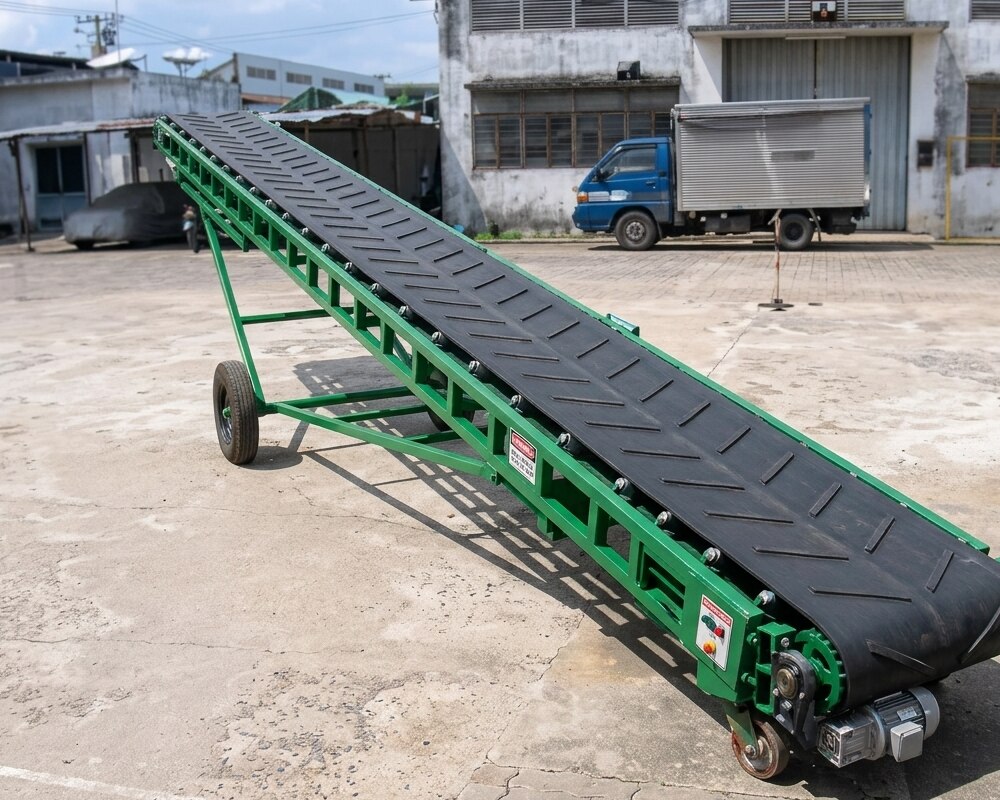
A flat belt suits horizontal or gently inclined routes carrying boxes, bags, cartons or a shallow, controlled layer of bulk material. Choose a troughed belt for loose bulk solids over longer distances; its formed trough retains more material, but a conventional smooth belt is commonly limited to about 15–20° for many dry materials.
| Option | Best route | Main limitation |
|---|---|---|
| Flat belt | Horizontal conveying, frequent loading or precise discharge to a chute | Spills on steeper inclines or with deep bulk loads |
| Troughed belt | Long runs carrying coal, grain, ore or aggregates | Needs correctly aligned loading and discharge transitions |
| Cleated belt | Inclines where flights hold a defined bed of material | Cleats complicate cleaning and can damage fragile products |
| Sidewall belt | Steep lifts or compact routes needing high vertical gain | Sidewalls and cleats increase inspection and cleaning demands |
| Enclosed belt | Dust-sensitive, weather-exposed or contamination-sensitive routes | Access, cleaning and transfer arrangements require more planning |
Use a cleated belt when regular flights stop material sliding backward. Use a sidewall belt when the route needs a steep incline, tight footprint or near-vertical lift; specify the cleat pitch, sidewall height and transition length together. Particle shape, moisture, belt cover and surface friction determine the actual angle.
Keep loading centred and aligned with belt travel, then accelerate the incoming stream near belt speed. Poor trajectory causes impact, spillage and mistracking. For sticky or wet material, specify discharge scrapers, secondary cleaners, pulley lagging and return-side washdown access, not just the carrying profile.
Convert tonnes per hour into belt width, speed and structural load
Start with peak mass flow, not the nominal tonnes-per-hour figure. Convert it to kilograms per hour and use Q = 3,600 × ρb × A × v, where ρb is the lowest credible bulk density, A is cross-sectional loading in square metres, and v is belt speed in metres per second. Include surge flow.
- Calculate A = Q ÷ (3,600 × ρb × v).
- Select belt width from A, the trough angle and the material’s surcharge angle; do not fill to the belt edge.
- Increase belt width for large lumps, off-centre loading or a high-drop transfer point.
- Set idler spacing closer in the loading zone and under heavy loads; wider idler spacing reduces cost but increases belt sag and frame loads.
- Check the selected belt speed against dust, spillage, degradation and transfer-point acceleration.
A low surcharge angle produces less usable area at the same belt width, so forcing capacity through excessive loading causes spillage and mistracking. Centre the incoming stream, align it with belt travel and bring its velocity close to belt speed.
Calculate drive power from lift, material acceleration, belt flexure, idler resistance, indentation rolling resistance, skirt friction and transfer losses. Then verify running tension, starting tension, take-up travel and allowable belt sag. Size the frame, pulleys, bearings and supports for belt tension, material weight, impact loads and wind or maintenance loads—not tonnes per hour alone.
An impact bed or closely spaced impact idlers protects the loading zone better than simply adding belt thickness.
Check whether a belt is the right conveyor for the distance
For the same material and handling distance, choose a belt when continuous horizontal movement, gentle handling and moderate energy use matter more than sealed transfer or vertical lifting.
| Conveyor | Best fit for the same route | Main limitation |
|---|---|---|
| Belt conveyor | Short transfer to long conveyor routes with steady bulk flow | Needs transfer alignment, take-up travel and protection against spillage |
| Screw conveyor | Short transfer, metering, mixing or enclosed movement over a modest distance | Power, wear and material heating rise with length; fragile particles can degrade |
| Bucket elevator | Vertical lifting where floor space is limited | It is not a substitute for a horizontal conveyor and needs controlled feeding and discharge |
| Pneumatic conveyor | Enclosed handling through long, complex or hygienically isolated routes | High energy demand, particle breakage and product separation can become serious |
| Chain conveyor | Heavy, hot or abrasive loads needing positive movement at low speed | Higher mechanical wear and noise than a belt for ordinary bulk transport |
A long conveyor needs more than a motor-power calculation based on lift. Check belt flexure, idler and indentation rolling resistance, skirt friction, acceleration, transfer losses, running tension, starting tension, take-up travel and belt sag. A belt that handles the tonnes per hour on paper can still slip, mistrack or overload its drive.
At each transfer, centre the incoming stream, align it with belt travel and bring it close to belt speed. Poor trajectory causes impact, spillage and belt wear even when the selected width and capacity are adequate.
Turn the selection into a testable specification and supplier brief
A supplier brief is complete only when it defines failure limits, test conditions and acceptance records—not just belt width and motor power. State the material’s particle size, bulk density, moisture, temperature, chemical concentration, batch rate, angle of repose and cleaning method.
1. For abrasive material, require the belt-cover grade, abrasion resistance result, impact rating, cover thickness, pulley diameter, idler spacing and loading-zone protection. Test the actual feed at design rate and inspect cover wear, cuts, skirt leakage and mistracking after a defined runtime.
2. For sticky or wet material, require a carryback limit and a cleaner arrangement covering primary and secondary scrapers, pulley lagging, return idlers and washdown drainage. Run the wettest material and confirm that buildup does not foul idlers or contaminate the next batch.
3. For hot or chemical material, record continuous and peak temperature, exposure time, chemical name, concentration and cleaning agents. Require documented heat resistance and chemical compatibility data, then perform an immersion or running test for swelling, cracking, hardening, delamination and tensile loss.
4. For food, require food-contact suitability for the belt, seals and lubricants, plus cleanable welds, drainage and accessible supports. For pharmaceutical service, demand a cleaning procedure and residue test; crevices, exposed threads and product-retaining transfer points are disqualifiers.
5. Require loaded-start testing on an incline, including starting torque, belt tension and take-up travel. Give Unique Enterprises this acceptance brief when comparing a conveyor proposal, so quoted equipment is judged against your material rather than a catalogue rating.
Frequently asked questions
How do you match belt construction to the material?
Identify the material’s failure mode first, then select the belt cover, carcass and splice for abrasion, impact, moisture, heat or contamination risks.
What information is needed to size belt width and speed?
Provide tonnes per hour, bulk density in operating conditions, particle size distribution, moisture, belt profile and the required conveying distance.
How does the conveyor profile affect selection?
The route profile determines the required incline, loading arrangement, discharge points, take-up arrangement and structural support.
When is a belt conveyor unsuitable for the distance?
Compare the route length, elevation changes, transfer points, maintenance access and total structural requirement against alternatives such as screw, drag or pneumatic conveying.